
Phantom Award Space: How to Avoid It From Hawaiʻi
⏱ 11 min read

Updated August 28, 2026
Quick overviewTap to expand
- Phantom award space is award availability that shows up in a search but will not actually ticket. The seat looks bookable right up until the second it isn't.
- The error message is not the expensive part. Transferring points into an airline program you cannot pull them back out of is the expensive part.
- Almost every case comes down to one of two things. Either the seat was never yours to book, or the data in front of you is stale.
- From Hawaiʻi, the repeat offenders are ANA out of HNL booked through a partner program, JAL through oneworld programs, and Air France or KLM space on your mainland connection to Europe.
- One habit fixes most of it. Walk the booking all the way to the payment page, inside the program whose points you plan to use, before you move a single point.
In this article
- What is phantom award space?
- What phantom space actually looks like
- Six warning signs you can spot in ten seconds
- Which Hawaiʻi routes get hit most often?
- How do I verify award space before I transfer?
- Holds, transfer lag, and the gap in between
- What if I already transferred and the seat is gone?
- Scottie's Take
- FAQ
What is phantom award space?
Phantom award space is award availability that appears bookable in a search but cannot actually be ticketed. You find the seat, you start the booking, and the airline refuses it. Sometimes it errors out at checkout, sometimes the price jumps, sometimes the seat just quietly disappears on your next search. You will also hear it called phantom availability or ghost availability. Same thing.
Here is the part that matters for us in Hawaiʻi. Getting to Tokyo in a lie flat seat, or over to Europe in business, usually means moving points from a flexible currency into an airline program first. That transfer is one way. So a seat count on a screen is not a promise. It is a lead.
The one rule
A seat count in a search result tells you where to look. Whether the airline will actually sell it to you depends on a second layer of rules that most search tools never see. Never treat a number on a screen as permission to transfer points.
What phantom space actually looks like
Ben Schlappig at One Mile at a Time frames the underlying problem well. Award discrepancies between programs come down to a handful of causes, and phantom space is one of them, because technology just does not work properly sometimes, especially when you are using one airline's website to search another airline's inventory. The clearest tell is a calendar that is too flat. Real saver award space is lumpy. It clusters on odd Tuesdays, it disappears over holidays, it shows up in ones and twos. When every single day of a month prices identically in business class, something upstream is broken.
This screenshot went around the points groups in late August 2026. It is a Flying Blue business class search, Los Angeles to Amsterdam, and every day in October reads 60,000 miles. So does August. So does September, November, December and January.
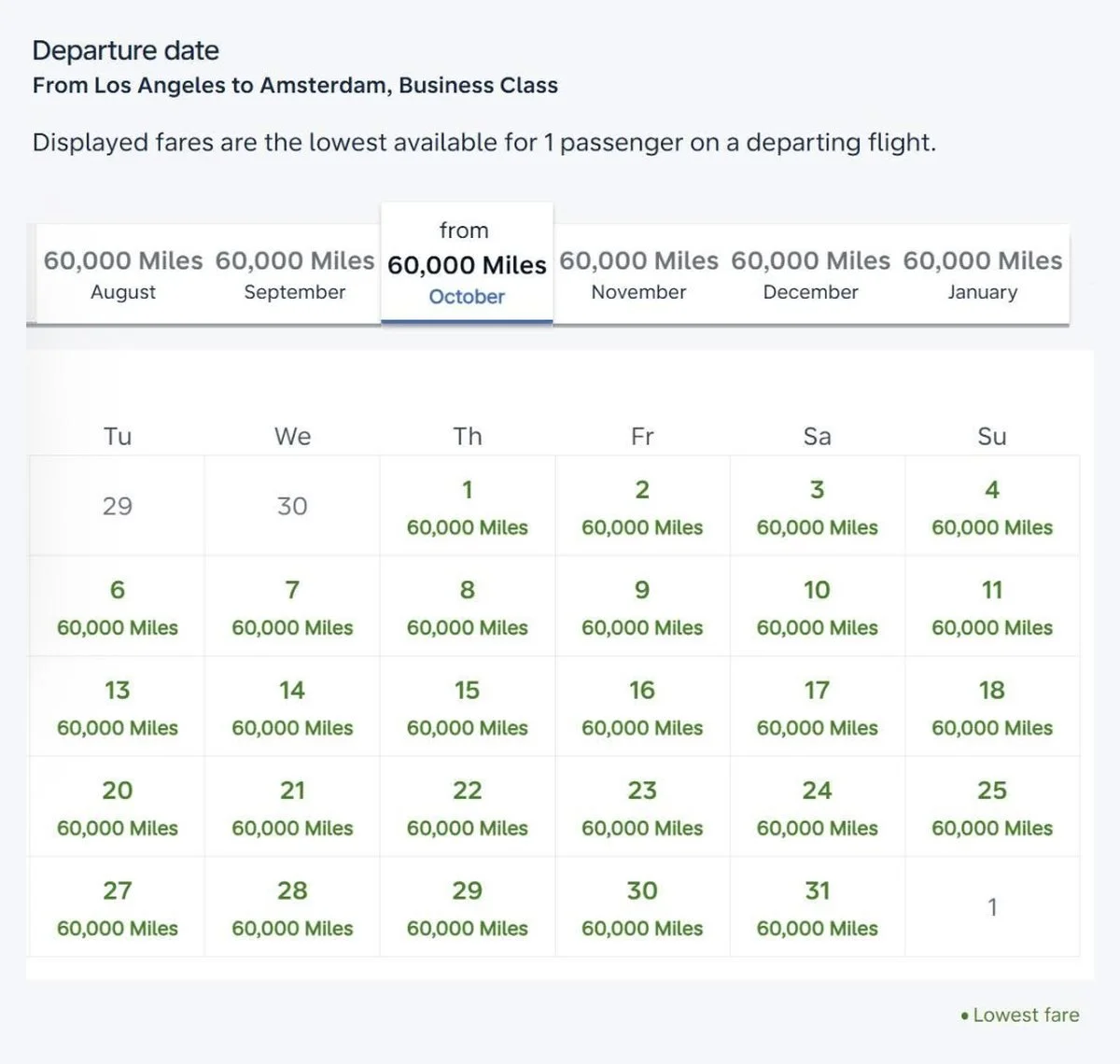
Travelers who transferred points against that display reported the booking failing at the final step. This was not an isolated bad day either. In a guide updated on August 26, 2026, The Points Guy noted that Seats.aero had recently flagged an increase in phantom space across Flying Blue, and that its own staff had run into phantom awards through American AAdvantage, United MileagePlus, Flying Blue and Air Canada Aeroplan.
Six warning signs you can spot in ten seconds
You do not need a subscription tool to catch most phantom space. You need pattern recognition. Two of the six below are published guidance from award search companies. The other four are my own read on the same underlying causes, so treat them as prompts to check rather than verdicts.

Which Hawaiʻi routes get hit most often?
Phantom space is not spread evenly. It concentrates on the exact routes we chase from here, because those routes involve partner airlines with tight inventory and multiple programs looking at the same seat through different windows. This is not an exhaustive list, just the ones that come up over and over in my inbox.
| Route | Where people try to book it | Why phantom shows up | What to check first |
|---|---|---|---|
| HNL to NRT ANA A380 Flying Honu, First and Business |
ANA Mileage Club, Aeroplan, United MileagePlus | Aeroplan has a long history of displaying ANA partner space it cannot always ticket. ANA waitlist space can also display as if it were confirmable. | Pull the same date and cabin on ana.co.jp. Confirm the seat is instant, not waitlisted. Booking through Virgin Atlantic by phone sidesteps the guesswork entirely. |
| HNL to HND ANA 787 |
Aeroplan, United MileagePlus | Same partner display gap, plus Aeroplan moved several partners to dynamic pricing in 2025, so the price you see may not be the price that tickets. | Confirm the live price in the program you will actually use before transferring. |
| HNL to HND or NRT Japan Airlines |
Atmos Rewards, AAdvantage, British Airways | Phantom JAL partner space is reported through both Atmos and AAdvantage depending on route and date, and the website and phone can disagree. | Cross check a second oneworld program, then push the booking to the payment page. |
| HNL to the mainland Alaska and Hawaiian premium cabins |
Atmos Rewards | Less a phantom seat, more a phantom cabin. Mixed cabin awards get displayed as premium when one leg is actually economy. | Check the cabin on every single segment before you confirm. |
| HNL to Europe via LAX or SEA on Air France or KLM |
Flying Blue, Virgin Atlantic, other SkyTeam partners | Air France and KLM share one program but run two booking portals, and the same flight can behave differently on each. Late August 2026 saw a spike in reports. | Check both the Air France and KLM portals. Call to confirm partner space. |
| HNL to Asia or Europe via a Star Alliance long haul out of SFO or LAX |
Aeroplan, other Star partners | Ben Schlappig reported in December 2025 that United basically no longer makes Polaris business class awards available to partner programs like Aeroplan and LifeMiles, having moved that space into a bucket reserved for its own elites and cardholders. | Check united.com logged out to see what is genuinely partner bookable. |
Mechanisms compiled from AwardFares' 2026 phantom availability guide and The Points Guy, mapped to routes flown from Honolulu. Program rules change constantly, so verify with the operating airline close to booking.
If Tokyo is the goal, I go deeper on the actual booking paths in our guide to flying from Hawaiʻi to Japan. And if you are working with Atmos points on any of these, start with the Atmos Rewards guide, since the partner rules there changed more than most people realize.
How do I verify award space before I transfer?
Six steps, in order. The whole sequence takes about fifteen minutes, which is a rounding error next to the cost of stranding 80,000 points in a program you will never use again.
- Search in the program you will actually book with. Not the aggregator, not the alert email. Log into the airline program whose points you plan to use and run the search there. Aggregators are for finding leads, not for confirming them.
- Cross check a second partner. Genuine partner space usually shows in more than one partner's system. If one lonely program can see it and nobody else can, that is suspicion, not discovery.
- Go to the operating airline. The carrier flying the plane holds the most accurate inventory. Pull up the same flight, same date, same cabin on their own site. Just remember they can hold seats back that they will not give to partners, so this confirms the flight and the cabin, not your ability to book it.
- Walk it to the payment page. This is the step people skip and it is the one that does the work. Fill in passenger details, click through to the point where the program asks for miles and money. Phantom space almost always breaks right there. Hitting that error before you transfer costs you nothing.
- Put a hold on it if the program allows one. A hold converts a risky transfer into a safe one. Some programs will hold a seat by phone even with an empty account.
- Transfer only what you need, then book immediately. Move the exact number of points for that itinerary, not a comfortable buffer. Then book the second they post.
Quick tip
Step four is the whole article. If you take nothing else from this, take the habit of clicking through to the payment page before you move points. Every other step is insurance on top of it.
Holds, transfer lag, and the gap in between
The dangerous window is the gap between hitting transfer and the points landing. Most transfers post instantly. A handful do not, and those are exactly the ones we use most often from Hawaiʻi.
ANA is the sharp edge here, and the reason is arithmetic rather than policy. ANA's own American Express page states that Membership Rewards transfers take two to four business days to reach an ANA Mileage Club account, that the points must post before seats can be reserved, and that once transferred the transaction cannot be reversed. ANA does allow award holds, but only by phone and only for about two days. Run those two numbers against each other and you see the problem. The hold can expire before the points land.
Here is my own experience with this, and it cuts against how most people search. I have flown ANA business on the A380 out of Honolulu, and I booked those seats through Virgin Atlantic Flying Club rather than off a partner search screen. Virgin does not let you book ANA awards online at all. You have to call, and an agent finds and confirms the space with you while you are on the phone. That sounds like a hassle in 2026. It is actually the best protection in this entire article, because a human confirms the seat is real before you commit anything. Every ANA seat I have booked that way has been legitimate. Virgin also still prices ANA off a fixed award chart instead of dynamic pricing, which is getting rare.
Flying Blue sits on the friendly side of this. Its phone agents can hold an award for up to three days, and readers regularly report getting a hold placed with no miles in the account yet, sometimes for a small per ticket fee. That is exactly the tool you want on a route where the calendar looks suspiciously flat. Get the hold, then transfer.
Good to know
Transfer bonuses make this worse, not better. A 30 percent bonus creates urgency, urgency creates sloppy transfers, and a promo deadline is the single most common reason people move points before confirming a seat. If you are chasing a bonus, verify the seat first and let the deadline be the second consideration. I track the live ones on our transfer bonus page.
What if I already transferred and the seat is gone?
It is not automatically over. Work these in order before you write off the points.
- Call the program and ask the agent to long sell the segment. Phone agents can sometimes see and ticket inventory the website refuses to process. Have a screenshot of the availability and price ready before you dial.
- Try the operating airline directly, or a different partner program that can book the same plane. The seat may be real and simply gated away from the channel you tried.
- Wait and re-check. If the cause was a stale feed or a schedule change, genuine space sometimes reappears once the systems catch up. Set an alert rather than refreshing all night.
- Ask about a transfer reversal, but do not plan around it. Programs occasionally reverse a mistaken transfer. It is rare and entirely at their discretion. Treat every transfer as final, because it almost always is.
- Find the second best use of those points. Points parked in an airline program are not dead, just inconvenient. Sometimes booking a different trip beats waiting a year for a seat that may never open.
Scottie's Take
I love this hobby because it rewards patience, and phantom space is the purest test of that. Everything about an award alert is engineered to make you move fast. The seat is right there, the transfer button is right there, and the little voice in your head says someone else is about to grab it.
Here is what I actually do. When I find something good out of HNL, I do not touch my points. I open the operating airline's site in one tab and the program I plan to book with in another, and I click all the way to the payment screen. If it holds, I transfer. If it errors, I just saved myself a very expensive afternoon. That is it. That is the whole discipline, and it has saved me more times than any tool subscription has.
The Flying Honu is the exception that proves the point. That is the seat I want most out of Honolulu, and it is also the one where a screenshot means the least. So I stopped trusting screens for it entirely and just call Virgin Atlantic, because an agent confirming space out loud beats any search result I could take a picture of. Slower, yes. But I have never been burned doing it that way.
Missing a seat costs you a trip. Stranding 90,000 points costs you a year. That trade has never been close for me.
If you got caught by one of these recently, I would like to hear which program and which route. Drop it in the comments. The more of us who compare notes, the faster we all learn which displays to trust.
Frequently asked questions
Is phantom award space the same as ghost availability?
Yes. Ghost availability is the older term for the same problem. The community has mostly settled on phantom award space or phantom availability, but all three describe an award seat that displays as bookable and then refuses to ticket.
Can I get my points back after a failed award booking?
Usually not. Most transfers from a flexible currency into an airline program are one way, and programs reverse a mistaken transfer only rarely and at their own discretion. Plan as though every transfer is permanent, because in practice it is.
Why does ANA come up so often for Hawaiʻi travelers?
Two numbers stack badly. ANA's own site says Membership Rewards transfers take two to four business days to post and cannot be reversed. ANA does allow holds, but only by phone and only for about two days. On the Flying Honu out of Honolulu, that means your hold can run out before your points arrive.
Does a confirmation number mean I have the seat?
Not necessarily. A booking can receive a confirmation number without ever being ticketed, and an unticketed booking can be cancelled quietly. Confirm that you hold an actual ticket number and that the operating airline shows your reservation in their system.
Why is my business class award showing an economy leg?
That is a mixed cabin award, not phantom space. The long haul flies in business while a connection flies in economy, and the breakdown is often hidden until checkout. Atmos Rewards is a frequent source of this, so check the cabin on every segment before you confirm.
Do paid tools eliminate phantom space?
No tool can, because the cause lives inside airline inventory systems. Fresher data reduces stale results, which helps, but a tool cannot see the gating rules that decide whether a partner can actually sell you a seat. The payment page check still does the heavy lifting.
Which credit card points are safest for this?
The transferable ones. Points that live in a flexible program keep their optionality until the moment you commit them, which is exactly the flexibility phantom space eats. If you are building a balance from Hawaiʻi, start with the best cards for Hawaiʻi residents and keep the points flexible until a seat is confirmed.
Sources
- Ben Schlappig, "What Causes Airline Award Availability Discrepancies?", One Mile at a Time, updated November 14, 2025.
- Ben Schlappig, "Which Airlines Allow Award Ticket Holds?", One Mile at a Time, updated August 19, 2025. Source for every figure in the hold chart.
- Ben Schlappig, "The Sad Decline Of United Polaris Business Class Award Availability", One Mile at a Time, December 22, 2025.
- All Nippon Airways, American Express Membership Rewards transfer page, ANA Mileage Club. Source for the two to four business day transfer window and the no reversals rule.
- Germán Ceballos, "Phantom Availability: Why Award Seats Vanish and How to Avoid It", AwardFares, June 3, 2026. Source for the married segments, caching, mixed cabin and program by program breakdown.
- "Phantom award space: How to avoid it", The Points Guy, updated August 26, 2026. Source for the Seats.aero note on rising Flying Blue phantom space.
Our ʻOhana Program walks Hawaiʻi families through building the right points balance for the trips they actually want, and how to book them without stranding points along the way.
Learn about the ʻOhana Program